Saturday, 11 March 2017

The Birds so far

I've had 59 species so far in the square. It was easy to add them up retropectively because I put them all on Birdtrack.

The best I suppose was Waxwing when a flock of 45 appeared in some trees further down the street. By the time I went for my camera they were gone. There had been up to 200 in the Riverside Park earlier, which I saw, so presumably these were part of that group. I have just checked my records as the Chester-le-Street area does seem to be particularly good for this species and sure enough I've had them in 8 out of the last 10 winters and five times actually in the garden since I moved here.

Common Buzzards are doing well and I see them in the square frequently, often over the house. The photo below was taken just yesterday,  from the garden,  as it soared and called for some time gaining height

Common Buzzard - probably the commonest raptor - this bird was over the garden


The winter has been fairly mild again and the two pairs of Stonechat on the fell have survived


Stonechat - 2 pairs present but can disappear for periods

and it's been a decent year for Redwing hanging around as opposed to moving through.


Redwing in Brass Castle Meadow - a good winter for them


Two species of owl on the list so far (with Barn Owl seen in the adjacent 1km square) but Tawny Owl has not been heard as often as in the past presumbably due to the tree felling in Hermitage Wood. Little Owls are still at their 2 favoured spots though  are often not on show. I did manage to catch this pair last month .


Little Owl - Who can't love these birds


The fell has again had a regular flock of Redpoll, all Lessers by the look of things with one male being particlarly white underneath but far too dark above for anything else in my opinion. The best photo I managed to get of it is this rubbish shot.


Lesser Redpoll - rather white underneath but still a Lesser in my opinion


Last time I did this square bash in 2013 Green Woodpeckers were still fairly common and heard at on most ventures. Like some other areas on lowland north-east they have now virtually diappeared. I have not had one here  for 2 years now and the only record seems to be one seen outside the square at Daisy Hill early this year. I've spent some time looking for this one without any joy. Great-spotted Woodpeckers are of course still common.


Great Spotted Woodpecker in South Burn Wood


So that was a little run down of the birds so far, I'll do plant-life tomorrow and hope someting appears in the moth trap tonight, unlike last night.


Friday, 10 March 2017

Introduction to NZ2459

I thought that with the reincarnation of this Blog  that I should introduce the square of NZ2459 (and as an excuse to show some pictures of habitat). The majority of the square is Waldridge Fell, at least the southern and eastern part. For you out there who don’t know the area, Durham County Council says “Waldridge Fell is an extensive area of lowland heath (moorland less than 300m above sea level), and contains contains heather,bilberry and moorland grasses.These look stunning in late summer and autumn when the purple heather is in flower. Lowland heath is globally rare and makes it especially important to manage it carefully.Waldridge Fell has had many uses over the years; grazing, part of the Prince Bishops' hunting chase and even a military training ground during the Napoleonic Wars. Extensive coal mining took place from the early 1800's until 1963. Waldridge colliery and village community thrived here. The present car parks are named after the rows of houses that once stood here. "

It may also be the largest dog toilet inn the north-east! (my words but true).


Spring - Birch and Gorse dominating. [Most of the land in the distance is outside the square]

Summer - Heather  and Bracken dominates
Winter - Snow (on occassion) dominates

The fell has a fair few upland and especially acidic-liking  plants and animals and is an SSSI classed as dwarf shrub heathand, Included in the square is Wanister Bog which  is  an area of seasonally-flooded land and  is the only valley-mire in lowland County Durham. 


Wanister Bog

As well as the Fell there is Felledge Wood, an old, very damp alder wood with a bit of oak, birch, wild cherry and holly on either side of the South Burn, that enters the river Wear couple of mile away. Through quite shallow, there are little pools scattered about here and there


Felledge Wood early one morning

Slightly futher downstream to the north, the wood changes to birch and crack willow, this is the area I usually call South Burn Wood, distinguishing it from the wetter adjacent Felledge.

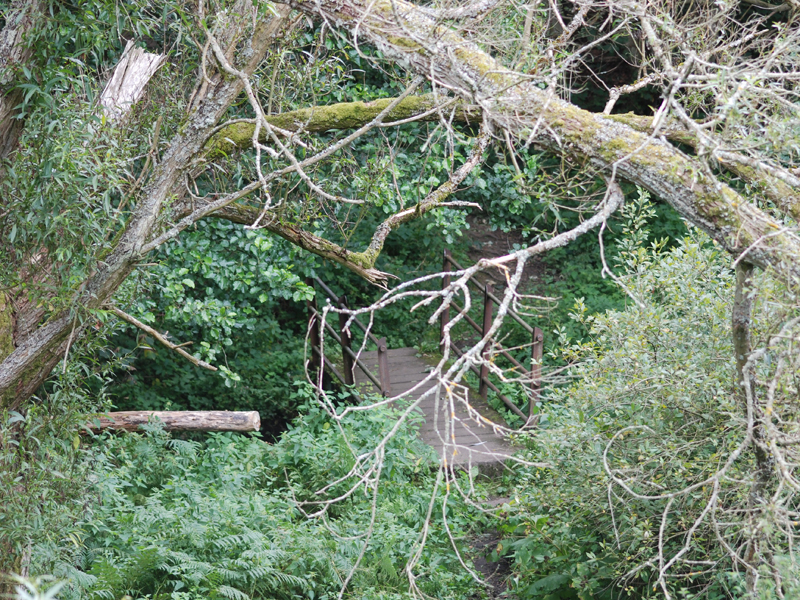
South Burn Wood, the burn is hidden under the bridge
 
 The northern third is made up of a few arable and rough pasture fields, the one just north of Brass Castle farm (a private dwelling) is the best meadow in the Waldridge area. The extreme NE corner has the start of the Waldridge Park estate where your’s truly lives. It would be daft not to cover a square that has your own house in, especially as it's amazing what is lurking in your own garden.

OK  - thats the Blog started. I'll mention what I've had to date  tomorrow and then we are off with whatever I can find the rest of the year


Saturday, 27 September 2014

A colourful tip

Today I  checked the the tip, aka the reclaimed waste tip behind Waldridge village. Despite it being nearly October and autumn arriving early this year there was still a good deal of colour about. Nothing of note bird-wise but the Tawny Owls have started to be vocal again and Willow Tits are still around in decent numbers, seen at 4 spots today. This are must be one of the best spots in the north-east for this rapidly declining species. More Nuthatches than usual, were seen, and especially heard, so I reckon must have had a good breeding season

A bit of red.
On many on the Dog Roses, Robin's Pincushion Gall was present. In fact I have never seen as much as today. This is a gall created by a Gall Wasp (Diplolepis rosae) and is created by a chemical produced by the wasp when the eggs are laid on a leaf or bud of the Dog Rose (Rosa canina). The chemical causes the rose to produce this red gall and inside the gall-wasp's eggs hatch and the grubs feed protected by this strange creation, Interestingly, the gall wasp involved is asexual  and less than 1% of the wasps hatching will be males.


A bit of pink.
There are still quite a few plants still in flower at the moment, including Common Centuary whcih is quite common on the old tip here, even though I don't recall seeing it anywhere else in the Waldridge/Chester-le-Street area.


A bit of black (plus a touch of yellow)
Fungi are starting to appear in decent numbers but it's very difficult to find any specimens that have not been attacked by Slugs at the moment. One of the commonest Waxcaps is Hygrocybe nigrescens (Blackening Waxcap), and there were a few of these on the tip today


Blackening Waxcap

A bit (a lot) of Brown
Most of the butterflies we won't see again until next year but Speckled Wood  were still flitting around in decent numbers. I saw 12 at least today, together with a  single Wall Brown.


Speckled Wood (top) and Wall
 
A bit of gold (hopefully)

Some sun forecast tomorrow .. fingers crossed

Thursday, 4 September 2014

A new moth for me

The moth trap last night contained an Orange Sallow, my first new macro moth for ages.  Also some other uncommon species for the garden, Barred Chestnut, Autumnal Rustic and the micros Lobesia littoralis and Ypsolopha parenthesella as well a a couple migrant Diamond-back Moths and a Silver Y. I'm quite happy with that lot.

Also a new beetle for me Bradycellus ruficollis, which helps my pan-listing attempt on a tiny bit to 2613.


Orange Sallow

Sunday, 31 August 2014

My only post this month and only just

I have been very lazy with my posts and I have just managed to get a post in during August. I have been out and about but not only around here but a little further afield occasionally.
A little pastime I have challenged myself with is what is called Pan-Listing. Quite a few naturalists, many a great deal better than myself, have started listing and a very good site has been started.
here


As it says (copied verbatim from the site) -  "A pan-species list is a list of all the animals, plants, fungi and protists you have seen in Britain, Ireland and the Channel Islands. Whether a Daisy or a Death's-head Hawk-moth, a Killer Whale or a Killer Shrimp, all species count as equal on your pan-species list. Although this may seem like the trivialisation of natural history to the accumulation of a big list, it's what is behind the list - how you get there - that makes this approach to natural history so powerful. Add a healthy dose of competitiveness in the form of the rankings pages and thanks to Mark Telfer, pan-species listing was born. Will this bring about a 'renaissance of the all-round naturalist'?"

So I have been counting up all my species and trying for more, no matter what they are.  I'm on 2601 by the way #28.


The moth trap overnight caught  a rather poor selection with nothing new even for the year but today was just a walk around the fell to see what was about.  Late August is usually quite quiet around here for birds but today was an exception with a flock of 30 Tree Sparrow in the hedge along Waldridge Lane until they were flushed by no less than a juvenile Peregrine that then headed on eastwards.
 Willow Tits have declined by 85% in the UK so now the Fell seems to be one of their  last strongholds. I saw birds at 5 different spots today. Another rapidly declining species, is the Yellow Wagtail but one flew over the fell late morning.

The Horse-chestnut Leafminer is a tiny little moth with a big bad reputation that is causing havoc to Horse Chestnut trees in the UK. It did not arrive in Britain until 2002 but its rapid spread means its well established even in Waldridge now. One tree along Beany Lane is very badly affected I noticed this morning


The leafminer damage

 A lot of butterflies were out considering the time of year with Speckled Woods seemingly everywhere and Walls not far behind. Several Commas were also seen and a single Painted Lady.


Comma (showing it's 'comma')

On the dragonfly front single Common and Southern Hawker  were noted as well as a few Black Darter at the same spot I found them last year and decent numbers of Common Darter, especially on Daisy Hill.

Immature male Common Darter

And I got one new 'lifer' a fruit fly  Xyphosia miliaria on thistle at the south end of Felledge Wood.


Tuesday, 29 July 2014

Bryotropha terrella at last

Put the trap out again last night, 185 moths of 54 species, but nothing really out of the ordinary except a small, dull grey micromoth with a scientific name of Bryotropha terrella. It's a common species, occurring in long grass and I should have seen one before but I hadn't until this one in the moth trap this morning.

A couple of the rest

Least Yellow Underwing

Antler Moth

Saturday, 26 July 2014

Fridays Moth trap

It took some time to go through everything in my moth trap the other morning  with 305 individuals of 67 species being present.

I'll not list them all but here's some pictures of a few of them

Garden Pebble


July High-flyer

Tawny-barred Angle

True-Lover's Knot

Brown-line Bright-eye