Monday, 20 March 2017

Mainly Moths

I mentioned the the day about that moth.  It was a small white Acleris moth, one of the micro-moths and I really wasn’t sure at all as to what it was. Anyway it turned out that after its bits were examined by the county recorder it was identified as Acleris logiana and the first for County Durham (VC66).  

231. Acleris logiana (Grey Birch Button)

That moth - Here she is (its a girl) A. logiana
 aka Black-headed Birch Leaffolder Moth or Grey Birch Button

The moth trap overnight produced three new moth species for the year in the way of 


232. Perigrapha munda  (Twin-spotted Quaker) 
233. Alsophila aescularia (March Moth )
234. Achlya flavicornis (Yellow-horned Moth)  


Twin-spotted Quaker

March Moth
Yellow-horned


Here's the Yellow-horned head on showing his antennae 'horns'

Otherwise I went off-piste on an outing with the Durham Wildlife Trust Botany Group to Gainford in the south of the county today. The aim, which was successful, was to see Gagea lutea (Yellow Star-of-Bethlehem) in one of it’s few county sites. A nice day out with 70-odd species including much of the early spring woodland plants in flower.


Yellow Star-of-Bethlehem


Returning,  I walked from the A167 into the square and in one of the fields I picked up a Curlew feeding. Not a year tick but the first that wasn’t just flying over. Better still and only metres away from it were two Oystercatcher. Tick #235. I only had my macro lens with me so here is a very distant shot of them.
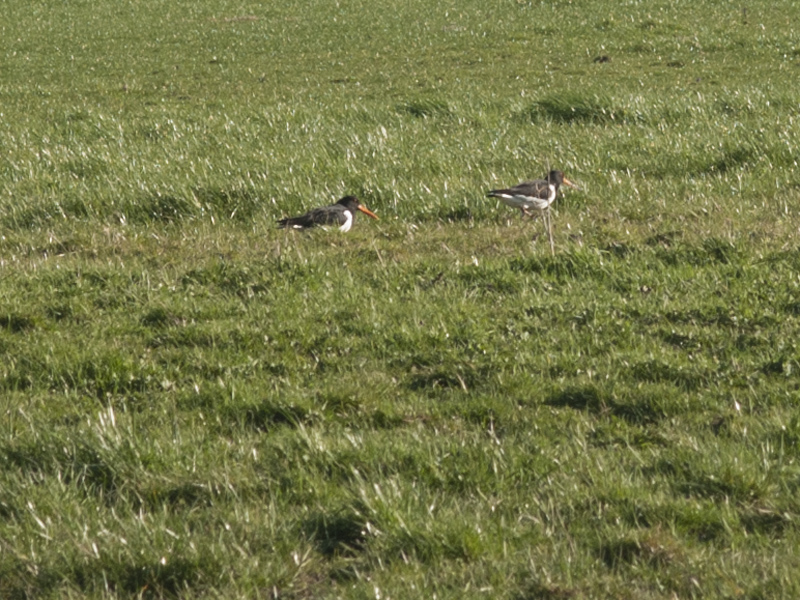


235. Haematopus ostralegus (Oystercatcher) 


Sunday, 19 March 2017

A mad rush to get the list up.

Didn't have much time today and looking at my target of 1000 species in a one kilometre square I thought I better get my finger out.
The idea was a quick walk around the fell but I never got further than the South Burn Woods as I desperately checked everything for new species.
The result was two species of Moss, 23 species of Flowering Plant, three fungi including a couple of Rusts and the Good old Common Frog.

202. Hypnum cupressiforme (Cypress-leaved Plait-moss)
203. Ulota crispa (Crisped Pincushion)

204. Bellis perennis (Daisy) - must have missed this one 
205. Cirsium arvense (Creeping Thistle)
206. Cotoneaster horizontalis  (Broom) 
207. Deschampsia cespitosa   (Tufted Hair-grass)
208. Epilobium hirsutum (Great Willow-herb)
209. Fragaria  vesca (Wild Strawberry)
210. Hyacinthoides x massartiana (Hybrid Bluebell)
211. Juncus inflexus (Hard Rush)
212. Leucanthemum vulgare  (Ox-eye Daisy)
213. Linaria purpurea  (Purple Toadflax)
214. Meconopsis cambrica (Welsh Poppy)
215. Pilosella officinarum (Mouse-ear Hawkweed)
216. Plantago major (Grea Plantain)
217. Quercus petraea (Sessile Oak)
218. Rubus idaeus  (Raspberry)
219. Sagina procumbens (Procumbent Pearlwort)
220. Salix caprea (Goat Willow)
221. Stachys sylvatica (Hedge Woundwort)
222. Euphorbia peplus (Petty Spurge)
223. Veronica arvensis (Wall Speedwell) 
224. Veronica serpyllifolia (Thyme-leaved Speedwell)
225. Cytisus scoparius  (Broom)
226. Angelica sylvestris (Wild Angelica)

227. Puccinia punctiformis (Creeping Thistle Rust)
228. Milesina carpatorum (Male Fern Rust)
229. Bulgaria inquinans (Black Bulgar)

230. Rana temporaria (Common Frog)

Thats Ok but I need the temperature to warm up to start getting some invertebrates. I've got a few things in pots in the fridge to check from today and a few Lichens and Mosses to look at but they are going to have to wait.

I have one other thing in the bag, that moth from the other day. I'll tell you about that tomorrow.


Saturday, 18 March 2017

A new moth (but I know not what yet)

On the 15th, amongst the usual spring suspects in the garden moth trap was a white micro-moth I didn't recognise. I did a bit of research but couldn't find anything that really fitted. A post on Twitter didn't reaveal it's identity either. Today the county recorders for both Durham and Northumberland have seen it or the photos and seem to feel it is a new species for the county but one of two very similar species, either Acleris kochiella or Acleris logiana. I have handed the moth over to them and await with great interest. An excellent addition to the list  when it's sorted hopefully.


A species of Acleris micro moth - that I think when identified will be a first for County Durham

What I have identified  were a couple of new species for the year in the last two nights moth traps
192 Panolis flammea (Pine Beauty)
193 Plutella xylostella (Diamond-back Moth)


Plutella xylostella (Diamond-back Moth) - I have already had two in the trap which at this a time of year would normally be unusual but considering the mild winter and the millions that arrived last year its almost to be expected

Panolis flammea (Pine Beauty)- Another Spring moth.  The photos a bit blurred as it was whirring its wings ready to take off

Orthosia incerta (Clouded Draba) - another of the common spring Orthosia moths


Also a few  new plants
194 Ulmus glabra  (Wych Elm)
195 Holcus lanatus (Yorkshire-fog)
196 Lamium album (White Dead-nettle)
197 Teucrium scorodonia (Wood-sage)


Ulmus glabra  (Wych Elm) flowers which are hermaphrodite

and two Spiders, 1 in the house and 1 in the garden
198 Araneus diadematus(Common Garden Spider)
199 Tegenaria gigantea (Giant House Spider)


I don't find lichens particularly easy to identify,  to say the least,  but I have managed a couple of the easier and common ones. A species with the name Chewing Gum Lichen can be found quite easily on pavements as well as on trees, walls, lamp-posts and roofs. Smaller specimens look rather chewing gum on the pavemnet. It's very common. The other species I found is Lecanora chlarotera. This is a common species on tree trunks and looks like a grey, lumpy porridge.


200 Lecanora muralis (Chewing Gum Lichen)
201 Lecanora chlarotera


Thursday, 16 March 2017

Out of the square but 4 before I left

Went out of the square today looking for Sand Martin on the river. No, I didn't see any. A nice walk however with an 8 mile round trip and 45 species of bird seen, including 7 Common Buzzard, with 5 in the air together over Chester Moor, 5 singing Chiffchaff and  4 Oyster-catcher.

I did however manage to get 4 more for the square with a Queen Tree Bumblebee feeding on the crocuses in the garden before I left, and on the orbital road Wood Burdock and Teasel both beginning to show their new leaves. Leaving the best till last, also here I had a single Orange Underwing moth over the birches. This moth flies in sunny weather over the tops of birch trees in early spring, and like Purple Hairstreak butterflies, usually best seen through binoculars, like this one.  Though I see it nearly every year this is my earliest ever record of this day-flying moth.


188. Arctium nemorosum (Wood Burdock)
189. Dipsacus fullonum (Wild Teasel)
190. Bombus hypnorum (Tree Bumblebee)
191. Archiearis parthenias (Orange Underwing)

Tuesday, 14 March 2017

187 - Some bits and pieces

Continuing to improve, the moth trap this morning held 25 moths of 7 species

Agonopterix heracliana    a Micro-moth 1 
Biston strataria    Oak Beauty 2
Orthosia gothica    Hebrew Character 3
Xylocampa areola    Early Grey 9
Orthosia incerta    Clouded Drab 2
Orthosia cerasi        Common Quaker 7 
Orthosia cruda        Small Quaker 1

three of the above were new for the year

170  Clouded Drab 
171 Small Quaker
172 Agonopterix heracliana (aka Common Flat-body
)

Moth-wise the numbers will drop down next month when the willows catkins are out in full on the fell, as moths seem to prefer to feed on these so that they are barely  attracted  to the Mercury Vapour light on the trap. At least thats what I have found over the years trapping in this garden.


Oak Beauty

Common Quaker

Hebrew Character

Early Grey


Couple more species of flora growing that I hadn't noticed until now

173 Anthriscus sylvestris      Cow Parsley        
174 Geranium molle         Dove's-foot Cranesbill


Had a little walk around. Nothing new on the bird front but the next new one I suspect will be a summer visitor next month, probably a Blackcap or a Willow Warbler or even a Swallow as the latter seem to be arriving in the UK rather early this year. Did take a couple of pictures of Rook and Reed Bunting.


Reed Bunting

Rook

 
Checked the Brambles for leafmines and immediately found some including several that were still occupied. These are caused by a micro moth larvae Stigmella aurella and in one the grub was still present.

175 Stigmella aurella (a Micro Moth aka Golden Pygmy)

The leaf mine of  Stigmella aurella


Another very common lichen was photographed, one that is on many of the Hawthorns - the Golden Shield Lichen. Also a purple-coloured rust on many of the brambles, whose English name is not surprisingly, Violet Bramble Rust

176 Xanthoria parietina        Golden Shield Lichen
177 Phragmidium violaceum    Violet Bramble Rust  


Golden Shield Lichen  Xanthoria parietina a very common lichen in the woods

and a couple of very common land molluscs were found

178 Helix aspersa        Garden or Common Snail
179 Deroceras reticulatum      Grey Field Slug


I had gathered a few mosses yesterday which I went through using my microscope this afternoon and they were the following species, all new for the year

180 Lophocolea bidentata    Bifid Crestwort
181 Pellia epiphylla        Overleaf Pellia
182 Atrichum undulatum       Common Smoothcap
183 Dicranum majus        Greater Fork-moss
184 Bryum pseudotriquetrum    Marsh Bryum
185 Kindbergia praelonga    Common Feather-moss
186 Ceratodon purpureus        Redshank
187 Fissidens bryoides      Lesser Pocket-moss


Just a mossy bank in South Burn Woods  - but it holds a good variety  of Moss & Liverwort species.


I''ll finish with a picture of some tree bark.

Bark of one of the Grey Poplars in the wood. They never seem to have any moss or lichens on them nor ivy growing up.

Hopefully some more species tomorrow

Monday, 13 March 2017

The few bits left summary

So what else I have seen, actually not a lot but mainly because I haven’t been looking, until now.
There are 5 mammals I have come across so far, the very common Grey Squirrel and Rabbit, Roe Deer (on many occasions), a particularly tame Wood-mouse that feeds under the garden bird table and some Human Beings which according to the rules you count.

A Wood Mouse spends most early mornings before dawn  feeding under the bird table in the garden and has done for years. Presumably not the same one, and on occassion two.


The Moth trap I haven’t had out until this month but I always do the Friday night trapping as part of the Garden Moth scheme. Four typical moths for very early spring recorded so far but I’m aiming for 350 over the year.

The only beetle so far I found was on the windowsill - Otiorhynchus sulcatus the dreaded Vine Weevil.
A couple of woodlice species and single Millipede, Ant, Hoverfly and Bumble Bee make up the rest. I will have seen others but just never recorded it properly so I’m going to have to spend some time this week looking under stones etc to get these numbers up. I know I have at least 4 species of Earthworm in the garden and the first flies have started to appear for example.

 Added my first mollusc this morning with a Strawberry Snail (Trichia striolata) on the house wall.
The Moth trap was out last night. Nothing new but the numbers are improving.

Oak Beauty (Biston strataria)  1
Early Grey (Xylocampa areola)  2
Common Quaker (Orthosia cerasi)  9
Hebrew Character (Orthosia gothica)  1

I went for a little walk this morning.
14 additional plants today on my little walk around the sqaure. Nothing unusual and nothing new in flower either but checked that the Yew was still in South Burn Wood (of course it was), plus Wild Privet (not your garden species), Wavy Bittercress, a couple of ferns, Bulbous Buttercup, Bog Pondweed and few other bits and pieces. None really worth a photograph 

3 Linnets including a couple of birds paired up and singing were on the Fell and 2 singing Chiffchaffs were in the South Burn Wood. So the bird list moves to 61 species. I saw in total 35 species during the walk including a Tawny Owl in the woods, 2 Willow Tit and a fly over Curlew. Lots of bird song but not everything has paired up,  as by Wanister Bog there was a little mixed Tit flock with Blue, Great, Coal and Long-tailed Tit and 3 Goldcrest. But with singing Chiffchaffs it feels that spring has just started.

 So the list is on 169 and about to start proper

Sunday, 12 March 2017

And plantlife to date

So far I've had 60 species of flowering plants in the 1k square. The target is 375 species, which seems a lot but I managed it last time and unlike birds in particular they tend not to move, which makes things much easier.  So most of the species should still be where I had them last time. Obviously there is very little in flower at the moment and subsequently vey little worth photographing so far. There's quite a few trees in the list as I helped with the Durham Wildlife Trust Botany group last month and gathered quite a few twigs for two sessions of winter tree identification which were quite well attended. Non-tree/shrub-wise the few species so far seen in flower include Colt's-foot and  Common Whitlow-grass plus a few garden weeds such as Hairy Biittercress and Shepherd's-Purse.


Coltsfoot Tussilago farfara, the flowers appear well before the leaves, was late in flowering this year

Blackthorn Prunus spinosa - A lot has been planted, for example along the orbital road, but there are still the odd plants in many of teh hedgerows and as isolted bushes or small groups on Waldridge Fell and South Burn Wood.


I joined the newly formed DWT Botany group last year and though it's unlikely we'll ever vist the square (but never say never) I reckon it has incresed my knowledge of plants and may well help me identify a few new ones this year. We had Chris Metherell give us an excellent talk on Euphrasia (Eyebrights) last week and hopefully when they are out in June I can get around to sorting them out. I think there are two (at least) species on the fell which in the past I have just called E. nemorosa but after the talk, and a session on going through his herbarium I suspect neither are this species. We'll wait and see.


As well as flowering plants we have also done a fungus foray or two last autumn but I have hardly looked so far this year hence only 3 very common species.

Birch Polypore Piptoporus betulinus - one of the commonest and most noticable woodland fungi
Wrinkled Crust Fungi  Phlebia radiata - the pinky crust fungus common on dead trees and causing White Rot
Variable Oysterling Crepidotus variabilis - Another common species


Recently I attended a session on Sphagnum Moss identification at Stanley Moss near Tow Law, which was very informative.  Here at Wanister Bog and the adjacent Felledge Wood  there are 5 Sphagnum species. I saw 3 species last time (S. fallax, palustre and squarrosum) and with my new found knowledge relocated them surprsingly easily,  together with a 4th, S.cuspidatum,  the day after, while everything was still fresh in my mind.  That just leaves Sphagnum fibriatum, which I did see at Stanley Moss, to find here

 I had not got around to checking for much more yet and like fungi it will be getting a bit late for many species so will have to wait until later in the year to boost the numbers. Finally I managed to identify one algae so far, Trentepohlia abietina, which is the one that forms bright orange patches on tree trunks and 1 lichen, the very common Hammered Shield Lichen Parmelia sulcata

Hammered Shield Lichen Parmelia sulcata   - The lobes on this grey-green lichen have ridges and dents giving it a hammered look.
So thats the plants, fungi and there allies so far. I'll finish off tomorrow  with  the Mammals and the small number of insects and other invertebrates tomorrow then its updates as I see new spcies and plod on to the 1000 species mark.