Friday, 31 March 2017

300 by March achieved

Overnight  Wednesday/Thursday  the moth trap contents included a Conistra vaccinii (Chestnut), a common over-wintering moth and perhaps surprising that I did not have one until now. I needed to do some more jobs in the garden and I caught a fly in the greenhouse which keyed out as the common Calliphora vomitoria aka the Bluebottle.
I still had a few mosses from the other day to check out and new were new for the year and finally a Himalayan Cotoneaster seedling  was hiding in the garden, presumably bird sown as there are a few bushes around, I just can't remember exactly where. I'll probably trip over them now.

284. Calliphora vomitoria (Blowfly)
285. Conistra vaccinii (Chestnut)
286. Lophocolea heterophylla (Variable-leaved Crestwort)
287. Plagiomnium rostratum (Long-beaked Thyme-moss)
288. Cotoneaster simonsii (Himalayan Cotoneaster)

I checked last night's moth catch this morning, up before dawn but still after a pesky male Blackbird had started doing his rounds to see what was on offer. What looked very much like another Acleris logiana was on the outside of the trap but flew off before I could pot it up. If it was, then a small colony may have become established nearby and I should catch more.. heres hoping.
What I did catch

Yellow Horned   1
Red-Green Carpet  1 *
Brindled Pug   2 *
Early Tooth-striped   2 *
Early Thorn   2 *
Early Grey   6
Pale Pinion   1 *
Pine Beauty    2
Clouded Drab   4
Common Quaker  8
Hebrew Character   5
Oak Nycteoline   1 *

35 moths of 13 species (plus 1 that got away), 6 of them (marked *) were new for the year


Red-Green Carpet

Early Tooth-striped

Pale Pinion

Oak Nycteoline


289. Selenia dentaria (Early Thorn)
290. Trichopteryx carpinata (Early Tooth-striped)
291. Nycteola revayana (Oak Nycteoline)
292. Lithophane socia (Pale Pinion)
293. Eupithecia abbreviata (Brindled Pug)
294. Chloroclysta siterata (Red-Green Carpet)
The thing about doing the 1000 in 1 ksq i,  though it's not competitive, you still give youself targets and  about 3 weeks ago I was hoping to finish March on 300. There a chance I could catch something in the trap overnight, but unlikely 6 more. As I was going 'off-piste' mid-morning it seemed that 300 was just a hope, nothing more. However after such a good moth trap catch I talked myself into thinking it was still possible so I had a quick saunter onto the fell to look for some more plants. It wasn't too difficult to find some new ones, even if most were just showing a few leaves. 25 minutes later I had found the six new species which made me finish March on 300. 
The new ones were

295. Blechnum spicant (Hard Fern)
296. Anisantha sterilis (Barren Brome)
297. Lolium perenne (Perennial Rye-grass)
298. Senecio vulgaris (Groundsel)
299. Menyanthes trifoliata (Bogbean)
300. Rumex crispus  (Curled Dock)

 I'm happy.


Tuesday, 28 March 2017

Is that a funny Bird's-foot?

Yesterday in the garden again but I did manage to identify  my first worm, a Brandling Worm but much better was a Sand Martin that flew over, my first for the garden since 2011.
A good day for bird song by the sound of things as a Pied Wagtail sang from the compost heap briefly and a Yellowhammer from the wires at the end of the street.


A rare garden bird here, Pied Wagtail

and becoming rare but still fairly common here - Yellowhammer


Best catch of the year so far in the moth trap for both numbers and species but nothing new for the year.

276. Eisenia fetida (Brandling Worm)
277. Riparia riparia (Sand Martin)

I got a message from Stevie Evans later that he had just had a Tree Pipit on the Fell as well as a report of a Green Woodpecker. There was no chance of getting out then but the next day I was out and about sharpish.

The grid reference I got was inside my square, only just but there was no sign of it. It took about an hour to find it but it was outside the square by a good 200 metres, perching on a Rowan but flitting down and out of sight before appearing the other side. This meant having to walk around the burn to the other side to view. I ended up doing this several times getting some decent but very brief views and no photo. After about 15 minutes of this,  it just disappeared. I then walked back into NZ2549 and continued walking around for bits and bobs but it was rather cold and there was virtually nothing in the way of invertebrates about.  A few Buff-tailed Bumblebees and that was virtually that. I picked up a few flowers including Red Campion in flower and nearby some Bird's-foot-trefoil. In one area there were what I initially took as a yellow flowered plant but on further inspection it appeared that all the leading leaves of thyis plant were a pale lemon colour. I think it must been more Bird's-foot-trefoil and think it may have been covered over and become pale and straggly, though none of the other plants and grasses amongst it seem to be affected. A quick look online hasn't revealed anything so more research needed.


I can only think this is Bird's-foot trefoil, the leaves are identical to normal Lotus corniculatus nearby


278. Silene dioica (Red Campion)
279. Lotus corniculatus (Common Bird's-foot-trefoil)
280. Myosotis sylvatica (Wood Forget-me-not)

I have a good idea where the border of my square is and a patch of birches on a small slope are just inside (I have checked). There perched on top was the Tree Pipit. Again it kept flitting down but twice rose up and song-flight, unfortunately away from me. When it landed the second time I lost it and didn't see it again.
I headed over to Wanister Bog and found the Sphagnum moss I hadn't found last time - Spiky Bog-moss.  It is one of the easy ones to identify but I took a little bit home to confirm it's identity.

Sphagnum squarrosum


 As I headed back 1 Common Carder Bee flashed past and I followed it to some Deadnettles where it fed.

Bombus pascuorum (Common Carder Bee)

281. Anthus trivialis (Tree Pipit)
282. Sphagnum squarrosum (Spiky Bog-moss)
283. Bombus pascuorum (Common Carder Bee)

Three days in March left and another 17 to get to 300 by the end of the month is just about possible I hope

Sunday, 26 March 2017

.... and a Baker's Dozen more

Spent most of the weekend in the garden so I was never going to see much but with the glorious weather a few invertebrates started to make an appearance.
Three species of Bombus (Bumble-bee) appeared at some time during the weekend, but no B. pratorum (Early Bumblebee) yet. Also the first Andrena haemorrhoa (Early mining bee), which is quite regular in the garden in early spring and a record-breaking queen Vespula vulgaris (Common Wasp) which couuld be my first ever one seen in March.

A Small Tortoiseshell arrived in the garden mid afternoon today, the first butterfly.

The Small Tortoiseshell in the garden
Also in the garden Aira praecox (Early Hair-grass) which has been present since we moved here and probably long before that, as well as lots of Elytrigia repens (Common Couch)

I had gathered some moss (I'm no Rolling Stone ... sorry) the other day and spent a good while checking them out and another seven species were identified,  so another dozen for the list.


Yesterday
263. Aira praecox (Early Hair-grass) 
264. Elytrigia repens (Common Couch)
265. Andrena haemorrhoa (Early mining bee)
266. Vespula vulgaris (Common Wasp)
267. Mnium hornum (Swan's-neck Thyme-moss)
268. Plagiomnium affine (Many-fruited Thyme-moss)
269. Polytrichum commune var. commune (Common Haircap)
270. Campylopus introflexus (Heath Star Moss)
271. Marchantia polymorpha subsp. ruderalis (Common Liverwort) 

 Today
272. Bombus lucorum sens. lat. (White-tailed Bumble Bee)
273. Aglais urticae (Small Tortoiseshell)
274. Pseudotaxiphyllum elegans (Elegant Silk-moss)
275. Pseudoscleropodium purum (Neat Feather-moss)  


Saturday, 25 March 2017

A dozen bits and pieces

Not much more than a list today as only a few photos despite it being 9C and beautiful bright spring day, My main camera I usually carry around with me had to stay indoors as the outer cover became detached and I left it sticking together with a bit of superglue, which should do the trick.

A good day for raptors with 4 Common Buzzard, 2 Kestrel and 2 Sparrowhawk seen over the fell. There's been a serious increase in Chiffchaffs overnight as I counted 18 singing during my walk around.


Chiffchaff - not too bad considering this was with a macro lens


Picked up a dozen bits and pieces including my first Seven-spot Ladybird at long last.


Seven-spot Ladybird 

Also got my third Bumble-bee of the year, a large Red-tailed but only the one and that was in the garden. A single Buff-tailed was also seen and lots of Tree Bumblebees feeding mainly on the sallows.

Tree Bumblebee (Bombus hypnorum).
This one was feeding low down, unlike most of the others whiuch were high up in the sallows.


If you look at the Mostchatel picture from the previous post you can see that some of the leaves are covered in blackish/ dark brown spots. This is a rust fungus  Puccinia adoxae and tends to deform the leaves and sometimes the whole plant. It is apparently common in places where this plant grows. I also found another rust fungus - Uromyces junci on Hard Rush


Uromyces junci on Hard Rush


251. Bombus lapidarius (Large Red Tailed Bumble Bee)
252. Eristalis pertinax (a hoverfly)
253. Lamiastrum galeobdolon subsp. argentatum (Garden Yellow-archangel) - a well-established escape
254. Scilla siberica (Siberian Squill) - ditto
255. Oxalis acetosella  (Wood-sorrel)
256. Myosotis arvensis (Field Forget-me-not)
257. Hyacinthoides non-scripta  (Bluebell) 
258. Coccinella septempunctata (7-spot Ladybird)
259. Arianta arbustorum (Copse Snail)
260. Arion ater (Large Black Slug)
261. Uromyces junci (Rush Rust)
262. Puccinia adoxae (Moschatel Rust)


I've got a few Bryophytes and a spider to id and 2 days of warm weather forecast so with a bit of luck .

Friday, 24 March 2017

Town Hall Clocks and Jews-ears

2 days of wind, rain and even snow,  not the weather for boosting my list, but I needed to get out so yesterday I nipped out of the square to Rainton Meadows Nature Reserve. The reason - it has a hide, so somewhere to sit and drink coffee while its tipping down. Dry but not warm, the stone-built thing is always freezing whatever the weather, even in summer. It was worth it as I also got my first Little Ringed Plover of the year, it flew in while I was halfway through my sandwich.


Little Ringed Plover at Rainton Meadows.  My and the reserve's first of the year but sadly not in my square

The moth trap was only out the once and wind & rain stopped play,  so I haven't caught a thing the past couple of days.

A few days ago I caught a couple of small(-ish) bees both feeding on Dandelions while I was out on the fell. They have been in pots in the fridge, so as it was still raining this morning I got the Microscope out amd Falk's Field Guide to Bees of Great Britian and spent an hour or so keying them out. I managed to identify them down to species, both of which I have seen on the fell previously and had been confirmed by an expert,  so I'm fairly confident I've Id'd them correctly. They were

236. Andrena scotica (Chocolate Mining-bee) - male  
237. Lasioglossum cupromicans (Turquoise Furrow-bee) - female  

I popped ou mid afternoo for a couple of hours and picked up a couple more common mosses

238. Grimmia pulvinata (Grey-cushioned Grimmia
239. Amblystegium serpens (Creeping Feather-moss) 

Whilst out this afternoon in Felledge Wood I watched a Wren wanting to enter the brickwork of a viaduct over the stream but I was putting it off. I scrambled down the bank for a quick peek when presumbably it's mate flew out of the fully formed nest, well advanced for so early. Not really exciting but I cover this square often so know most of the plants and their whereabouts, but I found I was standing in a large 6 square metre patch of Moschatel ,  all in flower. The flowers are green, and in groups of  of five, and is also known as 'Town Hall Clock' because the flowers face out in four directions, like the four faces of a town clock. .Not a rare plant but new completely ,not just for the square,  but I've just checked,  and its new for the tetrad.


Adoxa moschatellina (Moschatel)  - a new tetrad record


240. Adoxa moschatellina (Moschatel)  
 

When I was a young birder first starting I remember reading and being told about identifying Crows. If there's more than two they are Rooks, as you never see Carrion Crows in groups, they prefer the solitary life. And it was true, but how things change. Rook numbers have dropped by 17% since 1995 where as Carrion Crows have increased by 13% in the same period. Now if you see a group of crows it could be either. On the fell late this afternoon I had a bit of a smile as little groups of Carrion Crows started arriving in a few trees by one of the paths. Eventually there were 63 in these trees, flying around, cawing and doing what crows do. A young woman was walking her dog along the path when the crows all took flight but instead of flying away they circled above her making quite a bit of noise. Her dog ran back and she must of thought it was Hitchcock's 'The Birds' all over again and she turned around and rapidly went back the way she came following her brave doggie.

The Birds


I wandered through the woods for a while picking up a few more plant species including the old boy,  the famous Black Poplar, the leaves are beginning to burst so there's still life in the him yet.


Look at the bark on that! Black Poplar -  Populus nigra subsp. betulifolia

241. Pinus nigra subsp. laricio  (Corsican Pine)       
242. Plantago lanceolata (Ribwort Plantain) 
243. Cirsium vulgare (Spear Thistle)
244. Rumex sanguineus (Wood Dock)
245. Impatiens glandulifera  (Himalayan Balsam) 
246. Mercurialis perennis (Dog's Mercury) 
247. Salix x fragilis (Crack Willow)
248. Aegopodium podagraria (Ground-elder)
249. Populus nigra subsp. betulifolia (Black Poplar)

Nearly every Elder around the edge of the wood has Auricularia auricula-judae (Jew's-ear Fungus) on some of their branches. Not just here but everywhere I go I'm seeing it at the moment  I've never as much as this year.


Auricularia auricula-judae (Jew's-ear Fungus)

250. Auricularia auricula-judae  (Jew's ear Fungus)

There' a few more but it's getting late so I'll finish on a nice round 250

Monday, 20 March 2017

Mainly Moths

I mentioned the the day about that moth.  It was a small white Acleris moth, one of the micro-moths and I really wasn’t sure at all as to what it was. Anyway it turned out that after its bits were examined by the county recorder it was identified as Acleris logiana and the first for County Durham (VC66).  

231. Acleris logiana (Grey Birch Button)

That moth - Here she is (its a girl) A. logiana
 aka Black-headed Birch Leaffolder Moth or Grey Birch Button

The moth trap overnight produced three new moth species for the year in the way of 


232. Perigrapha munda  (Twin-spotted Quaker) 
233. Alsophila aescularia (March Moth )
234. Achlya flavicornis (Yellow-horned Moth)  


Twin-spotted Quaker

March Moth
Yellow-horned


Here's the Yellow-horned head on showing his antennae 'horns'

Otherwise I went off-piste on an outing with the Durham Wildlife Trust Botany Group to Gainford in the south of the county today. The aim, which was successful, was to see Gagea lutea (Yellow Star-of-Bethlehem) in one of it’s few county sites. A nice day out with 70-odd species including much of the early spring woodland plants in flower.


Yellow Star-of-Bethlehem


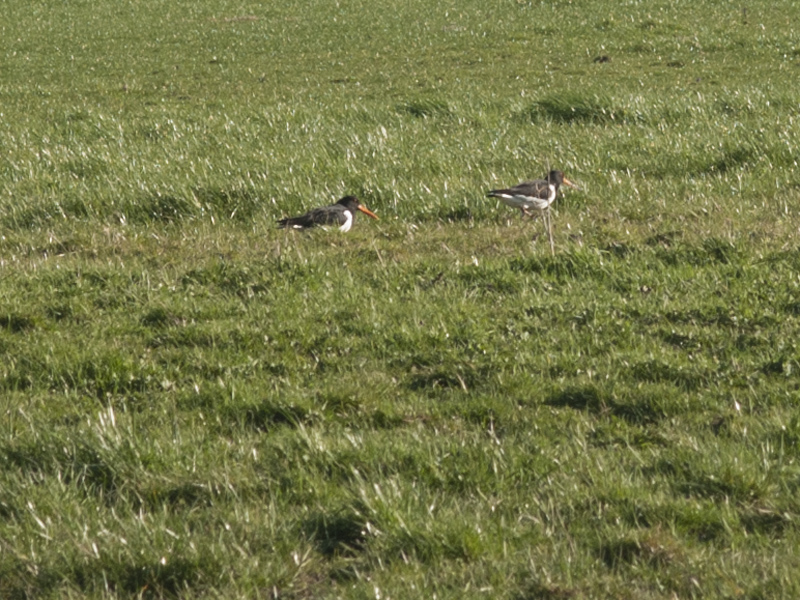
Returning,  I walked from the A167 into the square and in one of the fields I picked up a Curlew feeding. Not a year tick but the first that wasn’t just flying over. Better still and only metres away from it were two Oystercatcher. Tick #235. I only had my macro lens with me so here is a very distant shot of them.


235. Haematopus ostralegus (Oystercatcher) 


Sunday, 19 March 2017

A mad rush to get the list up.

Didn't have much time today and looking at my target of 1000 species in a one kilometre square I thought I better get my finger out.
The idea was a quick walk around the fell but I never got further than the South Burn Woods as I desperately checked everything for new species.
The result was two species of Moss, 23 species of Flowering Plant, three fungi including a couple of Rusts and the Good old Common Frog.

202. Hypnum cupressiforme (Cypress-leaved Plait-moss)
203. Ulota crispa (Crisped Pincushion)

204. Bellis perennis (Daisy) - must have missed this one 
205. Cirsium arvense (Creeping Thistle)
206. Cotoneaster horizontalis  (Broom) 
207. Deschampsia cespitosa   (Tufted Hair-grass)
208. Epilobium hirsutum (Great Willow-herb)
209. Fragaria  vesca (Wild Strawberry)
210. Hyacinthoides x massartiana (Hybrid Bluebell)
211. Juncus inflexus (Hard Rush)
212. Leucanthemum vulgare  (Ox-eye Daisy)
213. Linaria purpurea  (Purple Toadflax)
214. Meconopsis cambrica (Welsh Poppy)
215. Pilosella officinarum (Mouse-ear Hawkweed)
216. Plantago major (Grea Plantain)
217. Quercus petraea (Sessile Oak)
218. Rubus idaeus  (Raspberry)
219. Sagina procumbens (Procumbent Pearlwort)
220. Salix caprea (Goat Willow)
221. Stachys sylvatica (Hedge Woundwort)
222. Euphorbia peplus (Petty Spurge)
223. Veronica arvensis (Wall Speedwell) 
224. Veronica serpyllifolia (Thyme-leaved Speedwell)
225. Cytisus scoparius  (Broom)
226. Angelica sylvestris (Wild Angelica)

227. Puccinia punctiformis (Creeping Thistle Rust)
228. Milesina carpatorum (Male Fern Rust)
229. Bulgaria inquinans (Black Bulgar)

230. Rana temporaria (Common Frog)

Thats Ok but I need the temperature to warm up to start getting some invertebrates. I've got a few things in pots in the fridge to check from today and a few Lichens and Mosses to look at but they are going to have to wait.

I have one other thing in the bag, that moth from the other day. I'll tell you about that tomorrow.